
In the section of criticism at the end of the book, A.C.
Bradley writes: “That Hamlet was not far from insanity is very probable. His
adoption of the pretense of madness may well have been due in part to fear of
the reality; to an instinct of self-preservation, a forefeeling that the pretense
would enable him to give some utterance to the load that pressed on his heart
and brain, and a fear that he would be unable altogether to repress such
utterance” (p. 210).
Robert Ornstein writes: “When he exposes his inner
feelings in the first soliloquy we realize that Claudius has completely missed
the point. Hamlet’s problem is not to accept his father’s death but to accept a
world in which death has lost its meaning and its message for the living – a
world in which only the visitation of a Ghost restores some sense of the
mystery and awe of the grave” (page 261-262).
Carolyn Heilbrun writes: “At the play, the Queen asks
Hamlet to sit near her. She is clearly trying to make him feel he has a place
in the court of Denmark” (p. 269).
Related Books:

- Hamlet Before During After by Ben Crystal - This
is a volume in The Arden Shakespeare’s Springboard Shakespeare series, and
offers a good introduction to the play.
Regarding Hamlet’s soliloquys, Crystal writes, “something takes place in
the middle act of the play that drives the Prince to talk to us more
frequently; and then the need to talk to us seems to evaporate in the final
act” (p. 10). Regarding Hamlet’s switch
from “thy” to “your” in “Go thy ways to a nunnery. Where’s your father?”
Crystal writes: “It’s a fascinating switch. In many productions, it’s the point
when Hamlet becomes aware that someone is watching him – either from the way
Ophelia behaves, a noise from where Polonius and Claudius are hiding, or simply
a realisation that he’s been left alone with Ophelia for the first time in a
long time, and that that’s unusual…” (p. 18). Regarding Hamlet’s writing,
Crystal writes, “And when he asks Horatio to tell his story so his name won’t
go down in history as a mad, murderous Prince, but an avenging, honourable son,
does he pass on his notebook to his friend?” (p. 29). About the Ghost, Crystal
writes: “Marcellus’ line Thou art a
Scholar, speak to it Horatio is fitting. Scholars knew Latin, and Ghosts
were supposed to be talked to in Latin (as Hamlet later does). Also, they
weren’t supposed to speak first; humans had to start the conversation” (p. 31).
Regarding Ophelia returning the letters to Hamlet, Crystal writes: “I like the
fact that Polonius only asked her to sit and read, and hopefully talk to him.
It’s Ophelia’s own idea to use the
opportunity – presumably the first in two months – to formally bring their
relationship to an end” (p. 63). And regarding Laertes and Ophelia, Crystal
writes: “A thought – towards the end of the scene, were it not for Claudius
keeping him behind, with his Laertes, I
must commune with your grief, perhaps he might have run after his sister,
and been there to save her from her fate…?” (p. 90). And regarding the setting
itself, Crystal writes, “The Royal Castle Kronberg, in the town of Helsingor,
north of Copenhagen in Denmark, is the basis for Shakespeare’s Castle Elsinore”
(p. 127). He continues: “A huge maze of a castle, Kronberg – the seat of
Denmark – is a dramatic place with long corridors, tapestries on every wall.
While the towering cliffs Horatio warns Hamlet of don’t feature in the real
Denmark, other features are incredibly accurate. Visiting Elsinore, there is a
set of stairs going up into the lobby, and the casements (the tunnels
underpinning the four long exterior walls) were originally used to house the
army, and later, as gaols. It gives Hamlet’s line Denmark’s a prison a different resonance. Three actors who later
become colleagues of Shakespeare performed at the Castle in 1585, and many
understandably guess that they told the budding young actor-writer about their
trip” (p. 128).
This book was published in 2013.

- Stay, Illusion! The Hamlet
Doctrine by Simon Critchley and
Jamieson Webster - This book, by a husband and wife team, has
some interesting thoughts and interpretations. Some of it I agree with, some I
don’t. Regarding the play within the play, they write: “What are the sufferings
of Hecuba or indeed Hamlet to us? Yet, Hamlet would seem to be suggesting that
the manifest fiction of theater is the only vehicle in which the truth might be
presented” (p. 8). Regarding the Ghost, they write: “The ghost is nothing, of course, so Barnardo
confesses that he has seen it, that is, not seen it” (p. 26). Maybe, maybe not.
But an interesting idea. They write: “Might not Horatio be Fortinbras’s spy?
Think about it: the play finishes with a cordial exchange between Horatio and
Fortinbras where the latter declares, ‘Bear Hamlet like a soldier to the stage.’
But in this interpretation, such magnanimity is not surprising because Hamlet
has served as the perfect, albeit unknowing, conduit by which Fortinbras could
accede to the throne of Denmark. The pretender Hamlet murders Claudius but has
the decency to kill himself in the process and with his ‘dying voice’ says ‘th’
election lights/On Fortinbras.’ Take it a step further: let’s imagine that
Horatio and his paid accomplices, Marcellus and Barnardo, agree to concoct the
story of the ghost in order to dupe an already intensely fragile,
grief-stricken, and almost-suicidal young aristocrat. Hamlet unwittingly adds
the patina of psychotic delusion to their deception, and this is more than enough
to motivate the young prince to kill his uncle and clear the path for
Fortinbras. Horatio knows everything from the get-go because Hamlet is his
puppet and the ghost is his ruse” (p. 49). On the next page they admit that this
idea is far-fetched. No shit. It’s an interesting thought, but Bernardo is
clearly nervous and frightened by the Ghost before Hamlet ever appears. There
is a lot of stuff in this book about Freud and psychoanalysis that is loosely
related to Hamlet. And the writers
don’t understand what the word literally
means. They write, “The person identifies with the lost object and is literally
crushed by it” (p. 123). Wrong. And then again: “The lost other is literally
composed of desire” (p. 136). I don’t think anything can be literally composed
of desire. They draw a parallel
between Hamlet and Laertes: “So if Laertes is Hamlet’s double, then it is no
surprise that the play ends with their double murder. We have two groups, one a
reduplication of the other: Polonius, Laertes, Ophelia; and Claudius, Hamlet,
and Gertrude. By the end of the play Laertes is uncannily in the same position
as Hamlet: he has a father murdered, Ophelia lost, the support of the rabble
for the throne; he acts as an organ for Claudius’s scheming, and he desperately
seeks revenge” (p. 139). About Ophelia, the authors write: “She is always taken
as something to be used, as bait. No
one ever asks her what it is that she
wants. In her madness we see her desire explode onto the stage, immersed in a
voracious sexuality invariably denied to her” (p. 147). As for the book’s
title, it comes from a passage quoted from Nietzsche: “Knowledge kills action;
action requires the veils of illusion – that is the Hamlet Doctrine” (p. 195).
The authors write, “Hamlet’s inaction is caused not by a lack of energy but by
the knowledge that action is futile” (p. 202). And in their conclusion, the
authors state, “For us, at its deepest, this is a play about shame, the nothing
that is the experience of shame” (p. 228).
This book was published in
2013.



- Murder Most Foul: Hamlet Through
The Ages by David Bevington - In
the preface, author David Bevington explains: “The central argument of this
book is that the staging, criticism, and editing of Hamlet go hand in hand over the centuries, from 1599-1600 to the
present day, to such a remarkable extent that the history of Hamlet can be seen as a kind of paradigm
for the cultural history of the English-speaking world” (p.vii). Regarding the
earlier Hamlet, Bevington writes: “The likeliest candidate for authorship of a
lost Hamlet play in the years around
1589 would appear to be Thomas Kyd. His profile fits Nashe’s satirical
description of one who has left the trade of ‘noverint’ or copier of writs to
become a hack writer turning out whole Hamlets,
that is to say, handfuls, of overwrought tragical speeches” (p. 17). Regarding
the end of the Ghost scene, Bevington writes, “Hamlet makes a point of exiting
with the soldiers and Horatio together, rather than allowing them to yield him
precedence, as a way of insisting on their brotherhood of secrecy” (p. 35). Regarding
the Ghost’s line “Unhousled, disappointed, unaneled,” Bevington writes: “The
terms here, ‘Unhousled, disappointed, unaneled,’ have precise technical meanings
in Catholic theology. To die ‘unhousled’ is to die not having received the
Eucharist in the sacrament of Last Rites or Extreme Unction. This sacrament
requires an anointing by the priest of a person in danger of death, accompanied
by a set form of words, aimed at ensuring the eternal health of the soul. To be
‘disappointed’ is to be inadequately furnished for one’s journey into death. ‘Unaneled’
again means to have died without receiving Extreme Unction. Shakespeare does
indeed show here his familiarity with Catholic practice” (p. 63). Regarding Hamlet’s
supposed madness, Bevington writes, “Whether he is ever truly mad is a question
much discussed, as we shall see, though the text gives little if any support
for the notion that he really is so” (p. 68). Regarding the killing Polonius,
Bevington writes: “Hamlet appears to derive two insights form this miscarriage
of his plans. One is that swift, resolute action is not the uncomplicated
solution one might have hoped. The other is that he, Hamlet, will have to pay
for this killing of Polonius, just as Polonius has paid the price of his
meddling” (p. 70). Regarding the Restoration, Bevington writes: “Restoration
spectators and readers of Shakespeare generally applauded ‘improvements’ to his
text designed to elevate him to the high poetic status he deserved. Actors and
editors alike excised secondary characters, unified action according to the
classical unities, and attempted to render Hamlet
and other plays more symmetrical and spectacular by the incorporation of scenic
effects” (p. 92). He then writes, “The early eighteenth century is also the era
in which scholarly editing of Shakespeare’s texts began” (p. 93). He also
writes, “Hamlet criticism and editing
in the eighteenth century, then, is generally neoclassical in tone and method,
preferring classical regularity and decorum, albeit with some large exceptions
made for Shakespeare’s genius. Criticism of this period manifests an abiding
interesting in character more than in plot or theme. It seeks to appraise and
understand the moral purpose of the protagonist, and to measure the validity of
the play’s denouement by the standards of poetic justice. At the same time, the
late years of the century exhibit signs of change” (p. 106). About Henry
Irving, Bevington writes: “Irving’s interpretation of Hamlet was of a man
stricken with love for Ophelia – a not surprising emphasis, given the sympathy
expressed by many nineteenth-century critics for the suffering of such a
tender, innocent, and beautiful young woman. Even as Hamlet mocked her in their
painful overheard conversation (3.1), Irving’s Hamlet could not hide the depths
of his feeling for her; in the words of a contemporary reviewer, ‘his whole frame
seemed to tremble with heartfelt longing.’ To put this failed love relationship
in a fuller perspective, and to bestow on Hamlet the emotional sensitivity
worthy of such a lovelorn young man, Irving followed some of his predecessors
in deleting Hamlet’s soliloquy of implacable determination to send the kneeling
Claudius’s soul to hell” (p. 125). Regarding Bernardo, Bevington writes, “This
anxiety can explain why Bernardo asks the opening question, ‘Who’s there?’ when
it is Francisco, the guard currently on watch, who should issue that challenge”
(p. 130). Regarding Mark Rylance as Hamlet, Bevington writes: “In the Globe
space that invites chumminess and overstatement, Rylance was resourceful in
developing a rapport with audiences. He pointedly hurled at them Hamlet’s line
about how ‘groundlings’ are ‘capable of nothing but inexplicable dumb shows,’ then
adding, after they had objected vociferously at this, ‘and noise’” (p. 180). Bevington writes: “The phrase ‘Hamlet without
the Prince’ has entered the language as signifying a performance or an event
lacking the principal actor or central figure. The origin of this phrase is an
account in the London Morning Post,
September 1775, telling of a touring company which suddenly discovered that its
leading player had run off with the innkeeper’s daughter. The company had to
announce to the audience that ‘the part of Hamlet is to be left out, for that
night’” (pages 198-199).
This book was published in
2011.
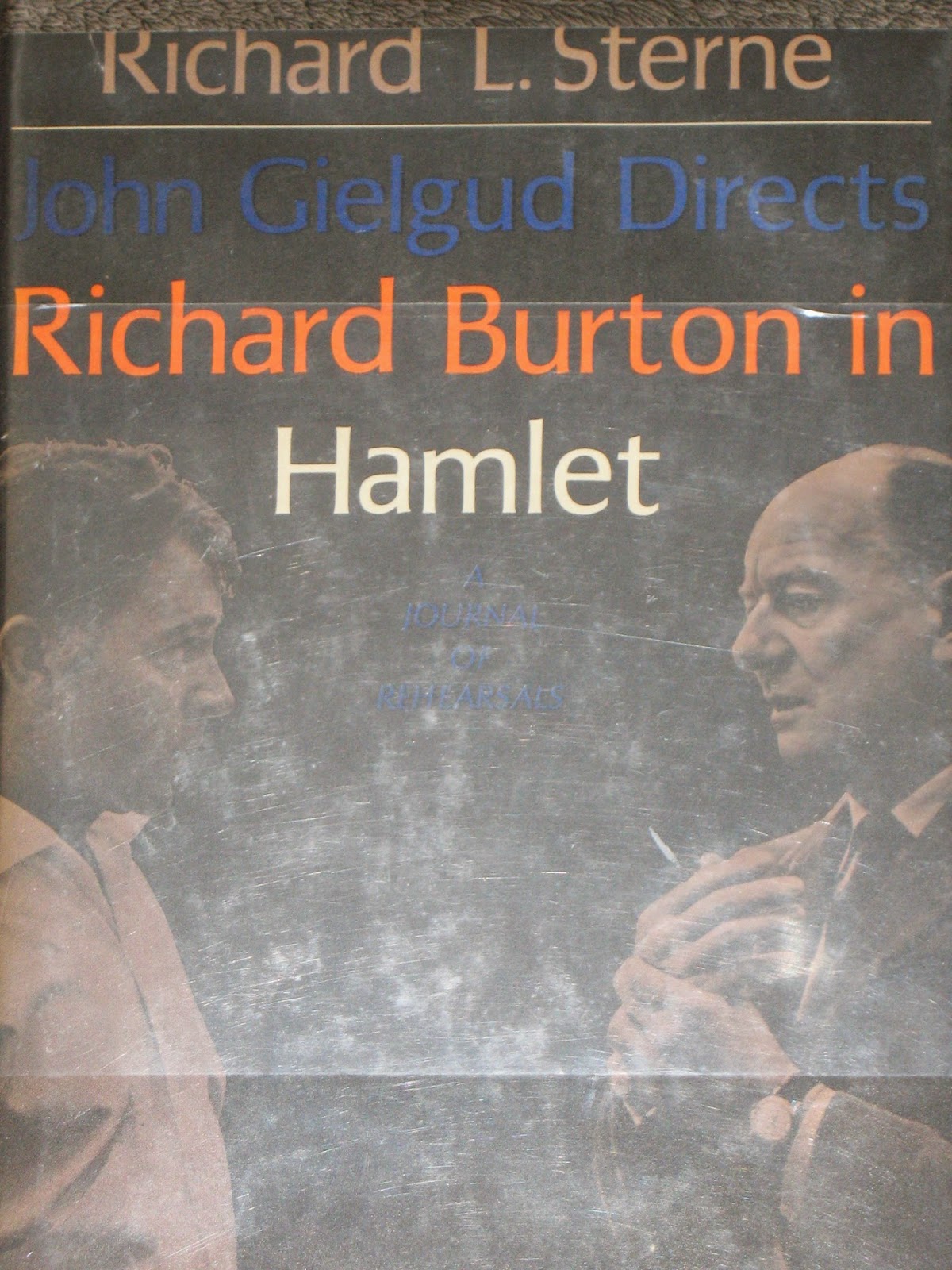
- John Gielgud Directs Richard
Burton In Hamlet by Richard L.
Sterne - This is a really interesting book, detailing
the rehearsal process of a production of Hamlet.
Richard L. Sterne secretly recorded the rehearsals, and so much of the book is
actual transcripts. Early on in the rehearsals, Gielgud says: “All the people
in the play are shut up in this castle. You play that, really, all through the
play. There is this curious feeling, except on the battlements and in the churchyard,
that they are all really locked in the castle, in a miasma of corruption and
sensuality. It isn’t until Fortinbras comes at the end that the whole thing
opens and all are free” (p. 17). Regarding Rosencrantz and Guildenstern,
Gielgud says: “When Hamlet says ‘What a piece of work is a man,’ they are the men he is referring to, and
he plays it to them as an expression of what he wants them to represent.
Otherwise, they just stand there with nothing to do and look like supers” (p.
29). Regarding the scene where Claudius is trying to pray, Gielgud says to
Richard Burton: “Hamlet is hurrying to his mother and stumbles on the King, and
in a frenzy grabs the sword and almost kills him without reflecting. The lines
and business must all go rapidly. I think you should whisper the speech” (p.
53). Regarding Hamlet’s departure and return, Gielgud says: “The fight with the
pirates and Hamlet’s departure are in the play to show the feeling of a
journey. Shakespeare does the same in Winter’s
Tale and Tempest. He was
fascinated by journeys because they were so much more important then and took
so much longer. And it has a tremendous effect on Hamlet in this play because
he comes back fantastically ready to carry out his mission without
complications. It’s only the sight of Ophelia’s body and Laertes jumping into
the grave, in which Hamlet suddenly sees this young man whom he always had
liked behaving exactly as he had done
when his father died, in a sort of
hysteria of grief. That makes him jump in and do all that violent stuff” (p.
56). The book contains the entire play as performed in this production, with
lots of notes on stage directions. They had an interesting take on the “Words,
words, words” line: “Words. (POLONIUS starts
to speak, but HAMLET cuts him off by
repeating more sharply) Words! (POLONIUS again tries to explain, pointing at the book and taking a step toward
him) WORDS!” (p. 186). The book ends with the transcripts of interviews
done with Richard Burton and John Gielgud. Regarding the duel with Laertes,
Gielgud says “That’s just a game, like football is to us. But he knows the end
is at hand. The King very cunningly sent Osric to play the fool in order to
divert Hamlet’s suspicion so that the wager will seem trivial and so he won’t
take it too seriously” (p. 297).
This book was published in 1967.
- William Shakespeare’s Hamlet adapted by Rebecca Dunn; illustrated by Ben
Dunn - This is a volume in the Graphic Shakespeare
series by Graphic Planet. It’s only forty-eight pages, and so is little more
than an outline of the play, just a few lines from most scenes. When the Ghost
tells of his murder, there are illustrations of Claudius flirting with Gertrude
and pouring the poison in the King’s ear. The Ghost doesn’t urge the others to
swear, and so the “Rest, rest, perturbed spirit” line is cut. Shockingly, a bit
of the Reynaldo scene is included. Because so much is cut, there are short
descriptions to fill in some of the information otherwise lost. However, we
also get this: “At the castle, the queen hires two of Hamlet’s friends to spy
on him” (p. 15). That’s making a bit of a jump from the information given in
the play. Many of the most famous lines are cut, including Polonius’ “brevity
is the soul of wit.” Oddly his “Though this be madness, yet there is method in ‘t”
is left in, but not Hamlet’s lines that lead him to say it. So it comes out of
nowhere. I think this book might be quite confusing to any people who are not
already familiar with the play. The “What a piece of work is a man” speech is
cut. It goes from “all custom of exercises” straight to “Man delights not me,”
an awful cut. Only the beginning of “To be or not to be” is included. It ends
with “mortal coil,” which is odd because that is mid-sentence, mid-thought. The
authors of this book clearly do not understand the play. No noise from behind
the arras alerts Hamlet to the presence of Claudius and Polonius, so Hamlet
exits, seemingly unaware of being watched. All the stuff about the recorder is
cut. The scene where Rosencrantz and Guildenstern ask Hamlet the location of Polonius
is cut. The “How all occasions do inform against me” speech is cut. Ophelia’s
mad scene is completely cut, which is ridiculous, especially as Laertes still
says “a sister driven into desperate terms” (p. 34). Act IV Scene ii is cut.
Another insane choice is that everything regarding Yorick is cut. The
gravedigger holds up a skull, but the next panel shows the funeral procession.
Hamlet puts his hood up and sneaks over to the coffin and sees Ophelia, rather
than learning of her identity through Laertes’ lines. All of the dialogue
between Hamlet and Horatio is cut (so no “special providence in the fall of a
sparrow”), as is Osric. Instead we get a very misleading panel: “Laertes and
Hamlet take their fight back to the castle…” (p. 40). Wrong, wrong, wrong. That
is so far removed from what Shakespeare wrote that all copies of this book
should be force-fed to its authors. Hamlet says “Is thy union here,” though all
of Claudius’ lines about the union are cut. More crazy cuts are at the end.
Gone is “The rest is silence.” Gone is Horatio’s famous speech. But Fortinbras
is left in. This is an absolutely terrible book and should be avoided.
It was published in 2009.
- Wittenberg: A
Tragical-Comical-Historical In Two Acts
by David Davalos - This play takes place before the events of Hamlet, with Hamlet at school, his major
as yet undeclared. The focus, however, is the dialogue between John Faustus and
Martin Luther. Faustus teaches philosophy, and Luther teaches theology at the
school. There are anachronistic jokes, such as “Two-stein minimum” (p. 9), and references to The Who’s “The Seeker,”
Robert Palmer’s “Bad Case Of Loving You (Doctor, Doctor)” and “Que Sera Sera.”
There are plenty of references to Hamlet.
For example, Faustus says: “…despite this being a Catholic university, we are
not going to be restricting ourselves to studying the philosophies of the
Church. There are, after all, more things in heaven and earth than are dreamt
of in its theology” (p. 12). At one point Hamlet says, “Being and not-being,”
to which Faustus responds, “Those are the questions, yes” (p. 18). And in that
scene, there is some business with a skull. There are more references to that
famous speech. Faustus says, “To believe or not to believe,” and Hamlet
responds, “That is the question” (p. 19). Still later, Faustus says, “To be or
not to be,” and Hamlet asks, “That is the question?” (p. 46). Faustus also
says, “You must shuffle off this moral coil” (a play on “mortal coil”). There
are plenty of other references to the play, including a reference to The Murder Of Gonzago, with Faustus
saying, “I hear they’re making it into a play” (p. 24). Hamlet and Laertes play
tennis, and of course there are several references to their duel in Hamlet. For example, Laertes says, “These
racquets have all a length?” (p. 37). The Judge says, “An out! A very palpable
out” (p. 37). The ghost of Mary appears to Hamlet much the way the ghost of his
own father appears to him in Hamlet.
She even bids him, “Remember me!” And the word association game has many
references to Hamlet. Faustus also
says, “After all, there really is no ‘good’ nor ‘bad,’ but thinking makes it so”
(p. 50), and Luther says, “His Providence is found even in the fall of a
sparrow” (p. 50), so clearly both of them have an impact on Hamlet’s thinking. There
is also a reference to The Tempest,
with Hamlet saying, “No more than such like stuff as dreams are made upon” (p.
10). In the play, Faustus nails Luther’s points to the church door. At the end,
Hamlet learns of his father’s death. There is also a joke on Shakespeare’s
play, with Faustus saying to Hamlet, “Live your life so that I may never have
to read of the tragedy of King Hamlet, yes?” (p. 61).
This book was published in
2010.

(Note: I've been posting reviews of film versions of Hamlet as separate blog entries.)
- Ghost Light by Tony Taccone - This
play is based on the experiences of Jon Moscone, whose father, Mayor George
Mascone, was assassinated along with Harvey Milk by Dan White in 1978. Hamlet is a significant part of the
story. In an early scene, Jon gets a message on his machine about costumes for
a production of Hamlet. He teaches a
master class in acting, and talks to his students about the Ghost in Hamlet. About Gertrude in the final
Ghost scene, he tells his students: “She’s watching her only son lose his mind
right in front of her very eyes. Her heart is breaking. And here’s the real
deal: she is actively trying to stop that from happening. She tries to control
him, to keep him from losing it, to keep her pain at bay” (p. 17). Jon’s advice
to the guy playing Hamlet, regarding the character’s seeming inability to act,
is: “You know somewhere, somewhere you know that in order to kill your father’s
murderer you have to kill off a part of yourself. The best part of your deepest
self. You have to learn how to hate. Become a villain to kill a villain. You
have to learn to hate yourself” (p. 28). References to the play are made by
other characters. For example, Prison Guard says, “Come on, let’s lug the guts
out of this here limbic system” (p. 20), a reference to Hamlet’s line about
Polonius. Louise says to Jon: “You were making a case for the time of the play
being a time of darkness and despair, and that if the court was really that
corrupt then Hamlet’s father had to be implicated as well, that he might have
been something less than the hero his son wants him to be. Which explains why
Hamlet is so completely paralyzed” (p. 48). Toward the end of the play, there
is a series of auditions for the part of the Ghost, and then Jon reads part of
the Ghost’s speech: “I am thy father’s spirit/Doomed for a certain term to walk
the night…” (p. 93).
This book was published in
2011.

